Famous Art of a Face Whale Held Up by Spears
Today Nantucket Island is a stylish summer resort: a place of T-shirt shops and trendy boutiques. Information technology's also a place of picture-perfect beaches where even at the height of summer you can pale out a wide swath of sand to phone call your own. Part of what makes the isle unique is its place on the map. More than than 25 miles off the coast of Massachusetts and only fourteen miles long, Nantucket is, as Herman Melville wrote in Moby-Dick, "abroad off shore." But what makes Nantucket truly different is its past. For a relatively brief period during the belatedly 18th and early 19th centuries, this lonely crescent of sand at the border of the Atlantic was the whaling capital of the globe and one of the wealthiest communities in America.
The bear witness of this bygone glory can yet be seen forth the upper reaches of the town's Primary Street, where the cobbles seem to dip and rise like an undulant ocean and where the houses—no matter how one thousand and magisterial—still evoke the humble spirituality of the island'southward Quaker by. And all the same lurking below this near ethereal surface is the story of a customs that sustained one of the bloodiest businesses the earth has ever known. It's a story that I hadn't begun to fully appreciate until afterward more than than a decade of living on the island when I started researching In the Center of the Ocean, a nonfictional account of the loss of the whaleship Essex, which I revisit here. While what happened to the crew of that ill-fated ship is an epic unto itself—and the inspiration behind the climax of Moby-Dick—just as compelling in its own quintessentially American manner is the island microcosm that the Nantucket whalemen called home.
**********
When the Essex departed from Nantucket for the last time in the summer of 1819, Nantucket had a population of about vii,000, well-nigh of whom lived on a gradually ascent hill crowded with houses and punctuated past windmills and church towers. Along the waterfront, four solid-make full wharves extended more than 100 yards into the harbor. Tied upwards to the wharves or anchored in the harbor were, typically, fifteen to 20 whale ships, forth with dozens of smaller vessels, mainly sloops and schooners that carried trade appurtenances to and from the isle. Stacks of oil casks lined each wharf as ii-wheeled, horse-drawn carts continually shuttled back and forth.
Nantucket was surrounded by a constantly shifting maze of shoals that made the elementary act of budgeted or departing the isle an oft harrowing and sometimes disastrous lesson in seamanship. Peculiarly in wintertime, when storms were the most deadly, wrecks occurred almost weekly. Interred beyond the island were the corpses of anonymous seamen who had done onto its wave-pummeled shores. Nantucket—"faraway land" in the language of the island's native inhabitants, the Wampanoag—was a deposit of sand eroding into an inexorable ocean, and all its residents, even if they had never sailed away from the island, were keenly aware of the inhumanity of the sea.
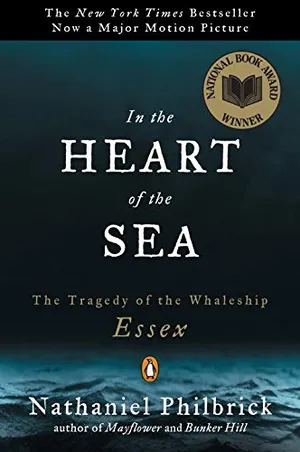
In the Centre of the Sea: The Tragedy of the Whaleship Essex
In 1820, an angry sperm whale sank the whaleship Essex, leaving its drastic crew to drift for more than than ninety days in three tiny boats. Nathaniel Philbrick reveal the chilling facts of this infamous maritime disaster. "In the Heart of the Sea"—and now, its ballsy adaptation for the screen—will forever identify the Essex tragedy in the American historical canon.
Nantucket's English language settlers, who beginning disembarked on the island in 1659, had been mindful of the sea'southward dangers. They had hoped to earn their livelihoods not as fishermen but as farmers and shepherds on this grassy island dotted with ponds, where no wolves preyed. But equally the burgeoning livestock herds, combined with the increasing number of farms, threatened to transform the isle into a windblown wasteland, Nantucketers inevitably turned seaward.
Every autumn, hundreds of right whales converged to the s of the island and remained until the early spring. Right whales—and then named because they were "the right whale to kill"—grazed the waters off Nantucket every bit if they were seagoing cattle, straining the food-rich surface of the ocean through the bushy plates of baleen in their perpetually grinning mouths. While English language settlers at Greatcoat Cod and eastern Long Island had already been pursuing correct whales for decades, no i on Nantucket had summoned the courage to set out in boats and hunt the whales. Instead they left the harvesting of whales that done ashore (known as drift whales) to the Wampanoag.
Around 1690, a grouping of Nantucketers was gathered on a hill overlooking the body of water where some whales were spouting and frolicking. One of the islanders nodded toward the whales and ocean beyond. "There," he said, "is a dark-green pasture where our children'due south
grandchildren will go for bread." In fulfillment of the prophecy, a Cape Codder, one Ichabod Paddock, was subsequently lured across Nantucket Audio to instruct the islanders in the art of killing whales.
Their start boats were only 20 feet long, launched from beaches forth the island'southward s shore. Typically a whaleboat's crew comprised v Wampanoag oarsmen, with a single white Nantucketer at the steering oar. Once they'd dispatched the whale, they towed it dorsum to the beach, where they sliced out the blab and boiled it into oil. Past the get-go of the 18th century, English language Nantucketers had introduced a system of debt servitude that provided a steady supply of Wampanoag labor. Without the native inhabitants, who outnumbered Nantucket'southward white population well into the 1720s, the island would never accept become a prosperous whaling port.
In 1712, a Captain Hussey, cruising in his little boat for right whales along Nantucket's due south shore, was pushed out to sea in a tearing northerly gale. Many miles out, he glimpsed several whales of an unfamiliar blazon. This whale's spout arched forward, different a correct whale'due south vertical spout. In spite of the high winds and crude seas, Hussey managed to harpoon and impale ane of the whales, its blood and oil calming the waves in nearly biblical style. This animate being, Hussey chop-chop perceived, was a sperm whale, one of which had washed upward on the island's southwest shore a few years earlier. Not simply was the oil derived from the sperm whale'southward blab far superior to that of the right whale, providing a brighter and cleaner-burning lite, but its cake-shaped caput independent a vast reservoir of even better oil, chosen spermaceti, that could simply be ladled into an awaiting cask. (It was spermaceti's resemblance to seminal fluid that gave rise to the sperm whale's name.) The sperm whale might take been faster and more ambitious than the right whale, but it was a far more than lucrative target. With no other source of livelihood, Nantucketers defended themselves to the single-minded pursuit of the sperm whale, and they soon surpassed their whaling rivals on the mainland and Long Island.
By 1760, the Nantucketers had about exterminated the local whale population. By that time, however, they had enlarged their whaling sloops and outfitted them with brick tryworks capable of processing the oil on the open ocean. At present, since information technology was no longer necessary to return to port every bit often to deliver bulky blubber, their fleet had a far greater range. By the advent of the American Revolution, Nantucketers had reached the verge of the Arctic Circle, the due west coast of Africa, the due east coast of Due south America and the Falkland Islands to the south.
In a speech earlier Parliament in 1775, the British statesman Edmund Burke cited the island's inhabitants as the leaders of a new American breed—a "recent people" whose success in whaling had exceeded the collective might of all of Europe. Living on an island nearly the aforementioned altitude from the mainland as England was from France, Nantucketers developed a British sense of themselves as a distinct and exceptional people, privileged citizens of what Ralph Waldo Emerson called the "Nation of Nantucket."
The Revolution and the War of 1812, when the British Navy preyed upon offshore shipping, proved catastrophic to the whale fishery. Fortunately, Nantucketers possessed sufficient capital and whaling expertise to survive these setbacks. By 1819, Nantucket was well positioned to repossess and, as the whalers ventured into the Pacific, fifty-fifty overtake its former glory. But the rise of the Pacific sperm whale fishery had a regrettable issue. Instead of voyages that had once averaged about nine months, two- and three-year voyages had go typical. Never before had the division between Nantucket'south whalemen and their people been so cracking. Long vanished was the era when Nantucketers could discover from shore as the men and boys of the isle pursued the whale. Nantucket was now the whaling capital of the world, but in that location were more than than a few islanders who had never glimpsed a whale.
Nantucket had forged an economical arrangement that no longer depended on the isle'southward natural resource. The isle'southward soil had long since been depleted by overfarming. Nantucket's large Wampanoag population had been reduced to a handful by epidemics, forcing shipowners to look to the mainland for coiffure. Whales had about completely disappeared from local waters. And notwithstanding the Nantucketers prospered. Equally one visitor observed, the island had become a "barren sandbank, fertilized with whale-oil only."
**********
Throughout the 17th century, English Nantucketers resisted all efforts to constitute a church building on the island, partly because a woman named Mary Coffin Starbuck forbade information technology. Information technology was said that null of importance was undertaken on Nantucket without her consent. Mary Coffin and Nathaniel Starbuck had been the get-go English couple married on the island, in 1662, and had established a assisting outpost for trading with the Wampanoag. Whenever an itinerant government minister arrived in Nantucket intending to constitute a congregation, he was summarily rebuffed by Mary Starbuck. And then, in 1702, she succumbed to a charismatic Quaker minister, John Richardson. Speaking before a grouping assembled in the Starbucks' living room, Richardson succeeded in moving her to tears. It was Mary Starbuck'south conversion to Quakerism that established the unique convergence of spirituality and covetousness that would underlie Nantucket'due south rise as a whaling port.
Nantucketers perceived no contradiction between their source of income and their organized religion. God himself had granted them dominion over the fishes of the body of water. Pacifist killers, plain-dressed millionaires, the whalemen of Nantucket (whom Herman Melville described as "Quakers with a vengeance") were simply enacting the Lord's volition.
On the corner of Main and Pleasant streets stood the Quakers' immense South Meetinghouse, constructed in 1792 from pieces of the fifty-fifty larger Great Meeting House that once loomed over the stoneless field of the Quaker Burying Basis at the end of Main Street. Instead of an exclusive identify of worship, the meetinghouse was open to nearly anyone. One visitor claimed that almost half those who attended a typical coming together (which sometimes attracted every bit many equally two,000 people—more than than a quarter of the island's population) were not Quakers.
While many of the attendees were there for the do good of their souls, those in their teens and early 20s tended to harbor other motives. No other identify on Nantucket offered a better opportunity for young people to meet members of the opposite sex. Nantucketer Charles Murphey described in a poem how immature men such every bit himself used the long intervals of silence typical of a Quaker coming together:
To sit with eager eyes directed
On all the dazzler at that place collected
And gaze with wonder while
in sessions
On all the various forms
and fashions.
**********
No matter how much this nominally Quaker customs might attempt to conceal it, there was a savagery about the island, a blood lust and pride that bound every mother, father and child in a clannish commitment to the hunt. The imprinting of a immature Nantucketer commenced at the earliest age. The showtime words a baby learned included the language of the chase—townor, for instance, a Wampanoag give-and-take signifying that the whale has been sighted for a 2d time. Bedtime stories told of killing whales and eluding cannibals in the Pacific. 1 mother agreeably recounted that her 9-year-old son affixed a fork to a brawl of darning cotton and then went on to harpoon the family cat. The mother entered the room just as the terrified pet attempted to escape, and unsure of what she had found herself in the centre of, she picked upwards the cotton ball. Like a veteran boatsteerer, the boy shouted, "Pay out, mother! Pay out! In that location she sounds through the window!"
At that place was rumored to be a hush-hush society of young women on the isle whose members vowed to midweek only men who had already killed a whale. To help these young women place them equally hunters, boatsteerers wore chockpins (modest oak pins used to secure the harpoon line in the bow groove of a whaleboat) on their lapels. Boatsteerers, outstanding athletes with prospects of lucrative captaincies, were considered the well-nigh eligible Nantucket bachelors.
Instead of toasting a person'south health, a Nantucketer offered invocations of a darker sort:
Decease to the living,
Long life to the killers,
Success to sailors' wives
And greasy luck to whalers.
Despite the bravado of this little ditty, expiry was a fact of life all too familiar among Nantucketers. In 1810 there were 472 fatherless children on Nantucket, while nearly a quarter of the women over the age of 23 (the boilerplate age of marriage) had lost their husbands to the sea.
Perhaps no community before or since has been so divided by its commitment to work. For a whaleman and his family, information technology was a punishing regimen: two to three years away, three to 4 months at dwelling house. With their men absent for so long, Nantucket's women were obliged not only to raise the children but also to oversee many of the island's businesses. It was women for the nearly role who maintained the complex web of personal and commercial relationships that kept the community functioning. The 19th-century feminist Lucretia Coffin Mott, who was born and raised on Nantucket, remembered how a husband returned from a voyage commonly followed in the wake of his wife, accompanying her to become-togethers with other wives. Mott, who eventually moved to Philadelphia, commented on how odd such a practice would have seemed to anyone from the mainland, where the sexes operated in entirely distinct social spheres.
Some of the Nantucket wives adapted readily to the rhythm of the whale fishery. The islander Eliza Brock recorded in her journal what she chosen the "Nantucket Daughter'south Song":
Then I'll haste to midweek a crewman,
and transport him off to body of water,
For a life of independence,
is the pleasant life for me.
But every now and then I shall
like to run into his face,
For information technology always seems to me to beam with manly grace....
Only when he says "Adieu my beloved, I'thousand off across the sea,"
First I cry for his departure, then laugh because I'grand free.
**********
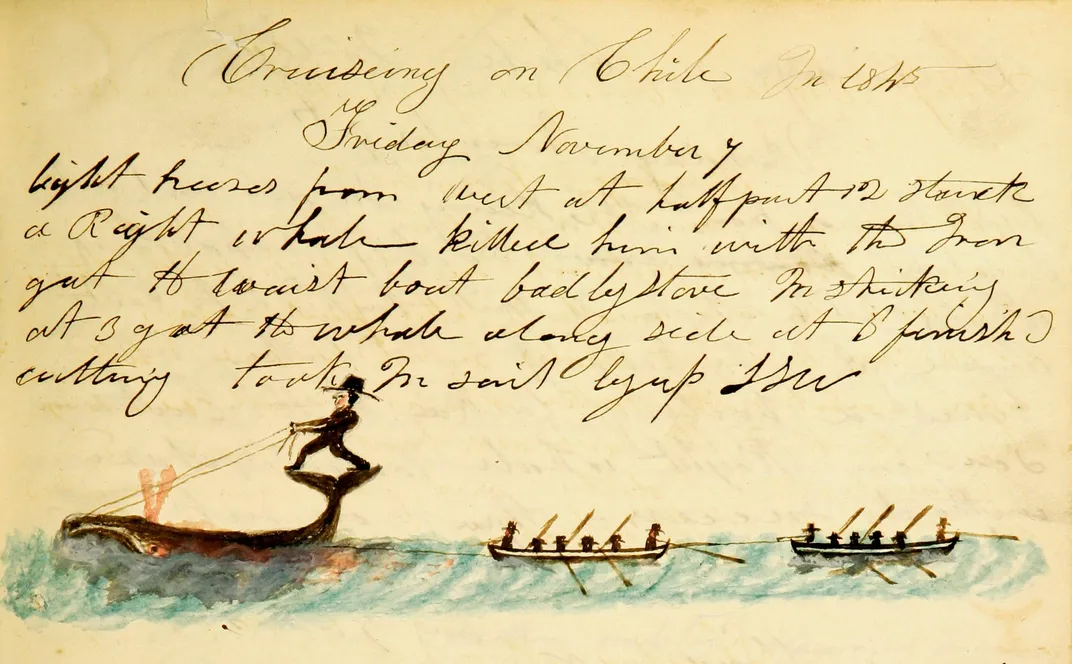
As their wives and sisters conducted their lives back on Nantucket, the island's men and boys pursued some of the largest mammals on world. In the early 19th century a typical whaleship had a coiffure of 21 men, 18 of whom were divided into 3 whaleboat crews of six men each. The 25-foot whaleboat was lightly built of cedar planks and powered by five long oars, with an officeholder continuing at the steering oar on the stern. The pull a fast one on was to row equally close as possible to their casualty so that the man at the bow could hurl his harpoon into the whale'due south glistening black flank. More than ofttimes than not the panicked fauna hurtled off in a drastic blitz, and the men constitute themselves in the midst of a "Nantucket sleigh ride." For the uninitiated, it was both exhilarating and terrifying to be pulled along at a speed that approached as much equally twenty miles an hr, the small open boat slapping against the waves with such force that the nails sometimes started from the planks at the bow and stern.
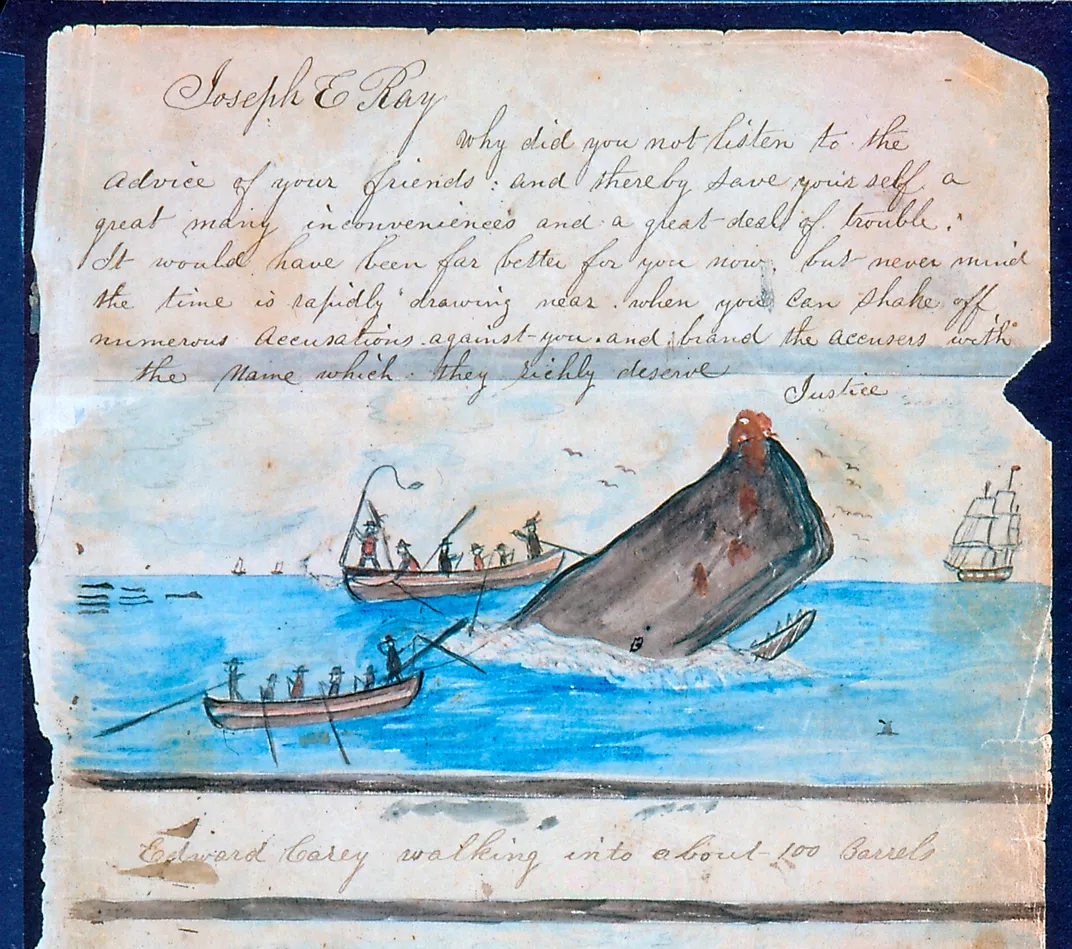
The harpoon did not kill the whale. It was the equivalent of a fishhook. After letting the whale exhaust itself, the men began to haul themselves, inch by inch, to inside stabbing distance of the whale. Taking up the 12-foot-long killing lance, the man at the bow probed for a group of coiled arteries near the whale's lungs with a violent churning motility. When the lance finally plunged into its target, the whale would begin to choke on its own claret, its spout transformed into a 15-foot geyser of gore that prompted the men to shout, "Chimney'southward afire!" As the blood rained down on them, they took up the oars and backed furiously away, then paused to detect every bit the whale went into what was known as its "flurry." Pounding the water with its tail, snapping at the air with its jaws, the creature began to swim in an ever-tightening circumvolve. Then, just as abruptly as the attack had begun with the initial harpoon thrust, the hunt ended. The whale brutal motionless and silent, a giant black corpse floating fin upward in a slick of its own blood and vomit.
Now it was time to butcher the whale. After laboriously towing the corpse back to the vessel, the crew secured it to the send's side, the head toward the stern. So began the slow and bloody procedure of peeling five-foot-wide strips of blubber from the whale; the sections were then hacked into smaller pieces and fed into the two immense atomic number 26 trypots mounted on the deck. Wood was used to start the fires beneath the pots, only once the boiling process had commenced, crisp pieces of blubber floating on the surface were skimmed off and tossed into the burn for fuel. The flames that melted downwardly the whale's blubber were thus fed by the whale itself and produced a thick pall of black smoke with an unforgettable stench—"as though," one whaleman remembered, "all the odors in the globe were gathered together and being shaken up."
**********
During a typical voyage, a Nantucket whaleship might kill and procedure twoscore to 50 whales. The repetitious nature of the work—a whaler was, after all, a factory ship—desensitized the men to the awesome wonder of the whale. Instead of seeing their prey every bit a 50- to 60-ton creature whose brain was shut to half dozen times the size of their own (and, what perhaps should have been even more impressive in the all-male person world of the fishery, whose penis was as long equally they were tall), the whalemen preferred to remember of it as what one observer described every bit "a self-propelled tub of loftier-income lard." In truth, however, the whalemen had more than in common with their prey than they would have ever cared to admit.
In 1985 the sperm whale adept Hal Whitehead used a cruising sailboat fitted with sophisticated monitoring equipment to track sperm whales in the same waters that theEssex plied in the summertime and autumn of 1820. Whitehead establish that the typical pod of whales, which ranges between 3 and 20 or so individuals, comprised almost exclusively interrelated adult females and immature whales. Adult males fabricated up only ii per centum of the whales he observed.
The females work cooperatively in taking care of their young. The calves are passed from whale to whale so that an adult is always continuing guard when the mother is feeding on squid thousands of feet below the ocean's surface. Every bit an older whale raises its flukes at the beginning of a long swoop, the dogie volition swim to another nearby adult.
Young males depart the family unit of measurement at around 6 years of age and make their way to the cooler waters of the loftier latitudes. Here they live singly or with other males, not returning to the warm waters of their birth until their late 20s. Even then, a male's return is fairly transient; he spends but 8 or so hours with any particular group, sometimes mating but never establishing strong attachments, earlier returning to the high latitudes.
The sperm whales' network of female-based family units resembled, to a remarkable degree, the community the whalemen had left dorsum home on Nantucket. In both societies the males were itinerants. In their pursuit of killing sperm whales the Nantucketers had developed a system of social relationships that mimicked those of their prey.
**********
Herman Melville chose Nantucket to be the port of thePequod inMoby-Dick, but it would not be until the summer of 1852—about a yr after publication of his whaling ballsy—that he visited the island for the commencement time. Past then Nantucket's whaling heyday was behind information technology. The mainland port of New Bedford had assumed the curtain as the nation's whaling capital, and in 1846 a devastating fire destroyed the island'due south oil-soaked waterfront. The Nantucketers apace rebuilt, this time in brick, simply the community had begun a decades-long descent into economical depression.
Melville, information technology turned out, was experiencing his own decline. Despite existence regarded today every bit a literary masterpiece,Moby-Dick was poorly received past both critics and the reading public. In 1852, Melville was a struggling author in desperate need of a holiday, and in July of that year he accompanied his father-in-law, Justice Lemuel Shaw, on a voyage to Nantucket. They probable stayed at what is now the Jared Coffin House at the corner of Center and Wide streets. Diagonally across from Melville's lodgings was the home of none other than George Pollard Jr., the former captain of theEssex.

Pollard, as it turned out, had gone to sea once again after the loss of theEssex, equally captain of the whaleshipTwo Brothers. That ship went down in a storm in the Pacific in 1823. All the crew members survived, just, every bit Pollard confessed during the return voyage to Nantucket, "No possessor will ever trust me with a whaleship once more, for all will say I am an unlucky homo."
Past the fourth dimension Melville visited Nantucket, George Pollard had become the town's nighttime watchman, and at some point the ii men met. "To the islanders he was a nobody," Melville later wrote, "to me, the most impressive man, tho' wholly unassuming even humble—that I ever encountered." Despite having suffered the worst of all possible disappointments, Pollard, who retained the watchman position until the stop of his life in 1870, had managed a way to keep on. Melville, who was doomed to die near 40 years subsequently in obscurity, had recognized a young man survivor.
**********
In Feb 2011—more a decade after publication of my bookIn the Heart of the Sea—came astonishing news. Archaeologists had located the underwater wreck of a 19th-century whaling vessel and solved a Nantucket mystery. Kelly Gleason Keogh was wrapping up a monthlong expedition in the remote Hawaiian Islands when she and her team indulged in some last-minute exploring. They set out to snorkel the waters virtually Shark Island, an uninhabited speck 600 miles northwest of Honolulu. After 15 minutes or so, Keogh and a colleague spotted a giant ballast some twenty feet below the surface. Minutes later, they came upon three trypots—cast-iron cauldrons used by whalers to render oil from blubber.
"We knew we were definitely looking at an former whaling ship," says Keogh, forty, a maritime archaeologist who works for the National Oceanic and Atmospheric Assistants and the Papahanaumokuakea Marine National Monument—at 140,000 square miles, the largest protected marine conservation area in the United states of america. Those artifacts, the divers knew, indicated that the transport likely came from Nantucket in the first half of the 19th century. Could it be, Keogh wondered, that they had stumbled across the long-lostTwo Brothers, infamous in whaling history as the 2d vessel that Capt. George Pollard Jr. managed to lose at sea?
TheTwo Brothers—a 217-ton, 84-pes-long vessel built in Hallowell, Maine, in 1804—also carried two otherEssex survivors, Thomas Nickerson and Charles Ramsdell. The ship departed Nantucket on November 26, 1821, and followed an established route, rounding Cape Horn. From the western declension of South America, Pollard sailed to Hawaii, making it as far equally the French Frigate Shoals, an atoll in the island chain that includes Shark Island. The waters, a maze of low-lying islands and reefs, were treacherous to navigate. The entire area, Keogh says, "acted a chip similar a send trap." Of the sixty vessels known to have gone downwards there, ten were whaleships, all of which sank during the height of Pacific whaling, between 1822 and 1867.
Bad weather had thrown off Pollard'southward lunar navigation. On the night of February 11, 1823, the sea effectually the transport suddenly churned white as theTwo Brothers hurtled against a reef. "The ship struck with a fearful crash, which whirled me head foremost to the other side of the motel," Nickerson wrote in an eyewitness account he produced some years after the shipwreck. "Captain Pollard seemed to stand amazed at the scene before him." Kickoff mate Eben Gardner recalled the final moments: "The body of water made information technology over us and in a few moments the ship was full of water."
Pollard and the crew of nigh 20 men escaped in two whaleboats. The next mean solar day, a vessel sailing nearby, theMartha, came to their aid. The men all eventually returned dwelling, including Pollard, who knew that he was, in his words, "utterly ruined."
Wrecks of old wooden sailing ships seldom resemble the intact hulks seen in movies. Organic materials such as wood and rope break downward; only durable objects, including those made from fe or glass, remain. The waters off the northwestern Hawaiian Islands are particularly turbulent; Keogh compares diving in that location to being tumbled inside a washing machine. "The wave actions, the common salt water, the creatures underwater have all taken their cost on the shipwreck," she says. "A lot of things afterward 100 years on the seafloor don't look like man-fabricated objects anymore."
The remains of Pollard'southward ship went undisturbed for 185 years. "No one had gone searching for these things," Keogh says. Following the discovery, Keogh traveled to Nantucket, where she conducted extensive archival research on theTwo Brothers and its unfortunate captain. The following yr she returned to the site and followed a trail of sunken bricks (originally used every bit ballast) to find a definitive clue to the ship's identity—harpoon tips that matched those produced in Nantucket during the 1820s. (TheIi Brothers was the only Nantucket whaler shipwrecked in these waters in that decade.) That finding, Keogh says, was the smoking gun. After a visit to the site turned up shards of cooking pots that matched advertisements in Nantucket newspapers from that era, the squad announced its discovery to the earth.
Nearly two centuries after the2 Brothersdeparted Nantucket, the objects aboard the ship have returned to the island. They are featured in an interactive exhibition chronicling the saga of the Essex and her crew, "Stove by a Whale," at the Nantucket Whaling Museum. The underwater finds, says Michael Harrison of the Nantucket Historical Association, are helping historians to "put some real bones to the story" of theIi Brothers.
The underwater investigation will keep. Archaeologists take institute hundreds of other artifacts, including blubber hooks, boosted anchors, the bases of gin and wine bottles. According to Keogh, she and her team were lucky to have spotted the site when they did. Recently, a fast-growing coral has encased some items on the seafloor. Notwithstanding, Keogh says, discoveries may notwithstanding await. "Sand is always shifting at the site," she says. "New artifacts may be revealed."
**********
In 2012 I received word of the possibility that my book might be made into a moving-picture show starring Chris Hemsworth and directed by Ron Howard. A twelvemonth after that, in Nov 2013, my wife, Melissa, and I visited the set at the Warner Brothers lot in Leavesden, England, about an hr outside London. There was a wharf extending out into a water tank about the size of two football game fields, with an 85-foot whaleship tied upwardly to the pilings. Amazingly authentic buildings lined the waterfront, including a construction that looked almost exactly similar the Pacific National Bank at the head of Main Street back on Nantucket. Iii hundred extras walked up and down the dingy streets. After having once tried to create this very scene through words, it all seemed strangely familiar. I don't know about Melissa, merely at that moment I had the surreal sense of being—even though I was more than than 3,000 miles abroad—home.
Additional reporting past Max Kutner and Katie Nodjimbadem.
**********

Post a Comment for "Famous Art of a Face Whale Held Up by Spears"