What Do Baby Koalas Do When They're Little
The breeding season for Koalas is approximately August to February. This is a fourth dimension of increased amovement for Koalas, with sound levels increasing as males bellow more than frequently. This is too when the young from the previous twelvemonth exit their mothers and disperse. This menses is the busiest for Koala carers, equally suburban Koalas are on the movement, crossing paths with cars and dogs, and college rates of stress-induced sickness.
Females by and large start breeding at about three or four years of age, usually producing ane offspring each year. However, not all females in a wild population volition breed each year; some produce offspring merely every two or three years, depending on factors such every bit age and habitat quality. In the average female person's 12-yr life span, she may produce five or 6 offspring over her lifetime.
Once conceived, it is only 35 days before the nativity of the infant Koala, called a "joey". The newborn is tiny (at roughly 2 centimetres long and less than i gram in weight), and looks like a pink jellybean; totally hairless, blind, with no ears.
The joey makes its way from the nativity culvert to the pouch completely unaided, relying on its already well-developed senses of smell and bear on, strong forelimbs and claws and innate sense of direction. Once inside the safety of the pouch, the joey attaches itself to one of the ii teats, which swells to fill its oral cavity. This prevents the joey from beingness dislodged from its food source. The female parent contracts her strong sphincter muscle at the pouch opening to foreclose the baby from falling out.
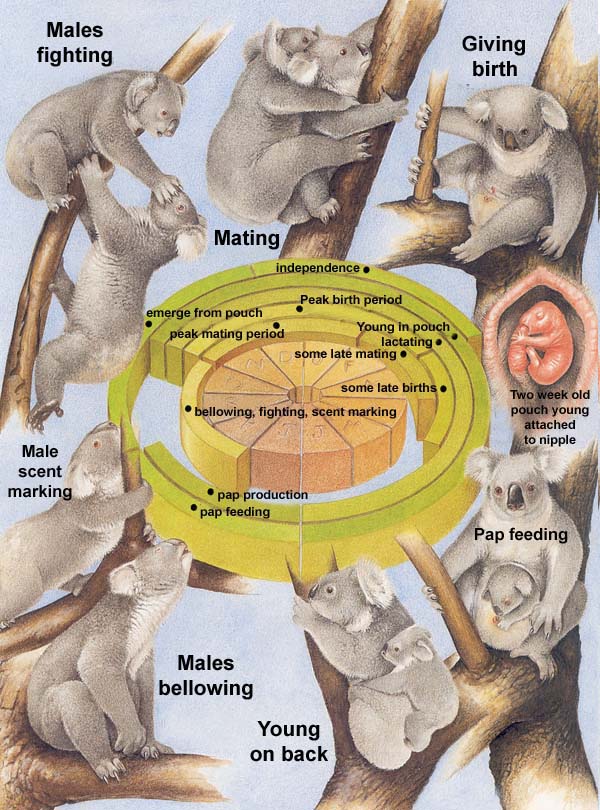
P.Schouten, From 'Koalas, the little Australians we'd all hate to lose' Beak Phillips AGPS
The immature Koala but drinks its mother's milk for the first vi to seven months and remains in the pouch for that fourth dimension, slowly growing and developing eyes, ears and fur. At nigh 22 weeks, its eyes open and information technology begins to peep out of the pouch. From about 22 to 30 weeks, it begins to feed upon a substance called "pap", which the mother produces in addition to milk. Pap is a specialised course of faeces, or debris, which forms an of import function of the young Koala's diet, allowing it to make the transition from milk to eucalyptus leaves, rather like a human babe is fed "mushy" food when it starts to swallow solids. Pap is soft and runny and idea to come from the caecum–a pouch connected to the junction of the small and large intestines. It allows the female parent to pass on micro-organisms present in her own digestive organisation to her joey, which are essential to the digestion of eucalyptus leaves, and is a rich source of protein.
The joey leans out of the pouch opening on the centre of the mother's belly to feed on the pap, stretching it open towards the source of the pap, and therefore 'downwards' or 'backwards'. This is why Koalas are sometimes said to accept a 'astern-opening' pouch, although this is not strictly true.
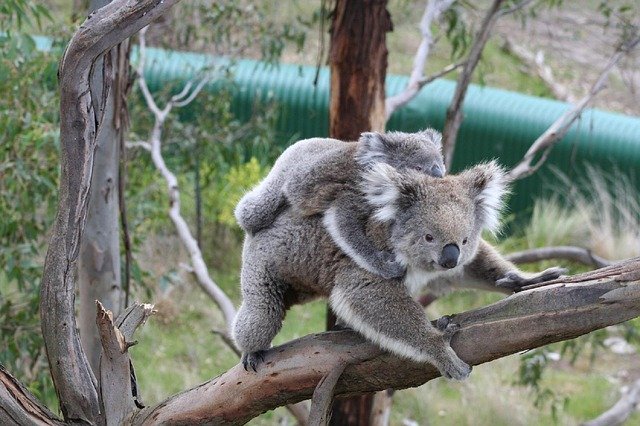
The baby feeds regularly on the pap, and as information technology grows information technology emerges totally from the pouch and lies on its female parent's abdomen to feed. Eventually it begins to feed upon fresh leaves every bit it rides on her back. The young Koala continues to accept milk from its female parent until it is about a yr old, only as it can no longer fit in the pouch, the mother'southward teat elongates to beetle from the pouch opening. Young Koalas remain with their mothers until the advent outside the pouch of the side by side season's joey. It is so time for the joey to disperse and detect its own dwelling range. If a female does not reproduce each year, the joey stays with her longer and has a greater chance of survival lonely.
Female Koalas by and large live longer than males, every bit the males are more often injured during fights, and occupy poorer habitat. Males also tend to travel longer distances. Putting a life span on the boilerplate Koala tin be misleading, as Koalas living in an undisturbed habitat would take a greater life expectancy than those living in suburbia. Some estimates for the boilerplate life-span of an adult wild male Koala are ten years, but the average survival rate for a dispersing sub-adult male living near a highway or a housing estate is closer to 2 or iii years.
All almost joeys — for kids!
Kangaroo babies aren't the just joeys! In fact all babe marsupials are called joeys — like Koala joeys, possum joeys, and sugar glider joeys. All baby marsupials accept a very interesting life, from the moment they are born to when they leave their mothers to make their manner in the earth of the Australian bush.
Koala joeys begin their life with an amazing journey
A Koala is born:
When the mother Koala gives birth, the little joey Koala makes its way to the pouch all by itself, with no help from its mother. One of the most amazing things about this is that the Koala joey is blind when it is built-in, and relies totally on its well-developed senses of touch and smell and strong forelimbs and claws to aid information technology get to the pouch.
Koala Joey Jelly-bean?:
The new-born joey weighs less than one gram and looks something like a pinkish jellybean. It is roughly 2cm long, blind, hairless, and looks very dissimilar to the beautiful, fluffy piddling bundle that it will become later. Once inside the rubber of its mother'due south pouch, the fiddling joey attaches itself to a teat which swells to fill its mouth. It takes several months for the joey to abound and develop, drinking its mother's milk until it first shows its lilliputian face to the world.
Another amazing matter about the life of a joey Koala:
When the joey is near half-dozen-7 months onetime it is ready to begin weaning from milk to gumleaves. To do this, the mother Koala passes on the micro-organisms in her stomach that are necessary to brand the digestion of gumleaves possible to her joey. She does this by producing a substance called 'pap' which is a specialised form of faeces (or koala poo). Dissimilar normal hard, dry Koala pellets, 'pap' is soft and runny in consistency.
Life outside the pouch:
As soon as it begins its diet of gumleaves, the young Koala grows at a much faster rate, becoming more audacious as it grows bigger and stronger. At commencement, the young Koala cuddles into its mother'south belly for warmth and shelter but as well rides on its mother's back. Eventually, the immature Koala will begin to brand short trips away from its mother.
All grown upward:
From 12 months onwards, Koala joeys leave their mothers to find their own habitation ranges. That'south when life gets harder for immature Koalas because they have to find their own territory — somewhere with the right tree species with tasty gumleaves to eat and somewhere nearly to other Koalas. And hopefully somewhere that is condom from threats similar habitat devastation, cars and dogs. The Australian Koala Foundation estimates that at least 4000 Koalas are killed by cars and dogs each yr and habitat destruction is the greatest threat to the Koala'southward long term survival.
Source: https://www.savethekoala.com/about-koalas/life-cycle-koala/

Post a Comment for "What Do Baby Koalas Do When They're Little"